
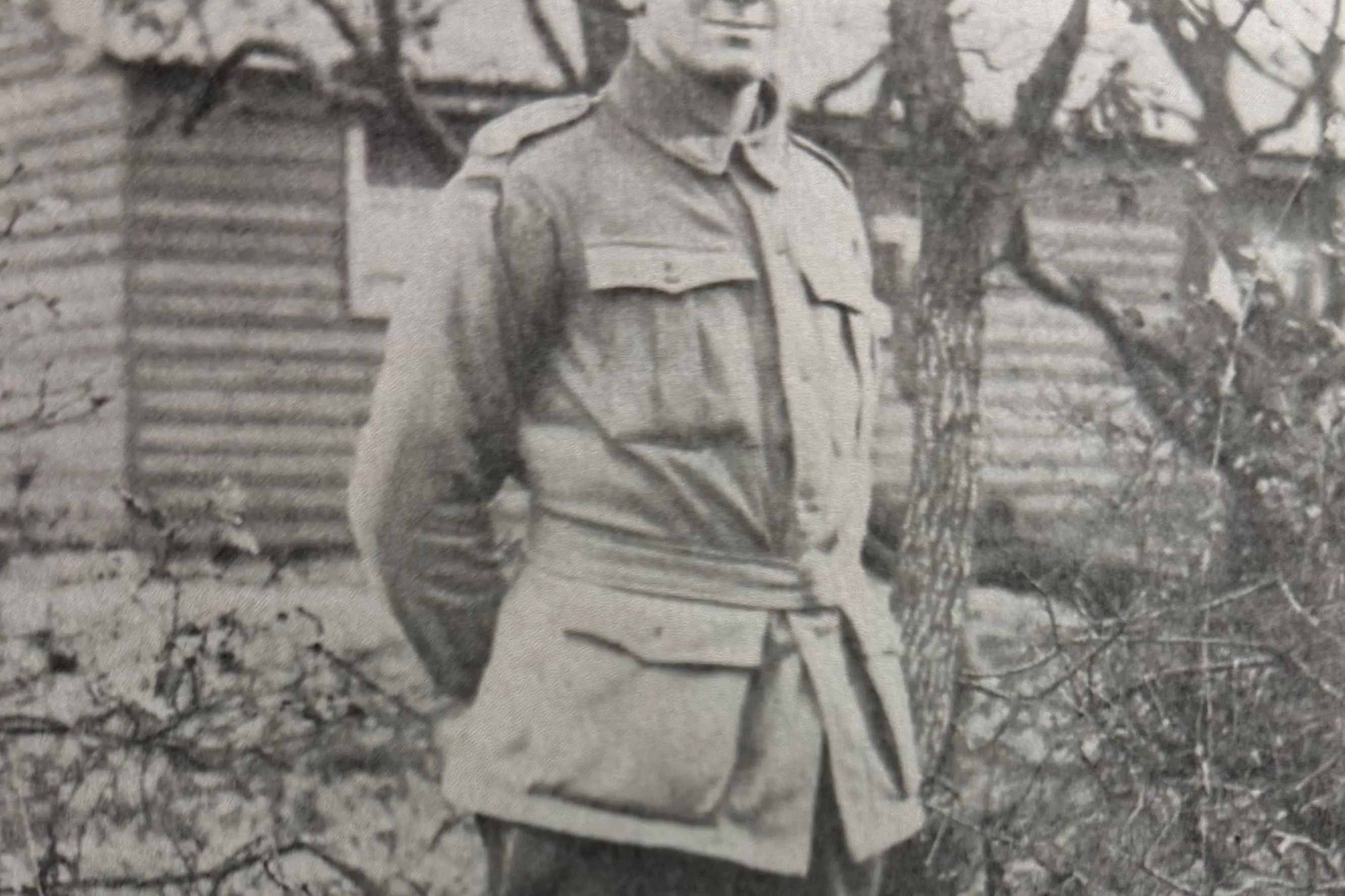
PHOTO
Here, in their own words and in the records carefully preserved by our community, are two Forbes stories that remind us why we come together on ANZAC Day.
These are stories of local men who stepped into the brutal world of war.
One was barely more than a schoolboy, the other a grown man who quietly subtracted a decade from his age so he could serve.
Both crossed half a world to face Gallipoli and the Western Front in World War I.
Through letters home, newspaper accounts and official records, we hear their voices across more than a century.
Archie William Muir was just 16 years and seven months when he enlisted for service in World War I and was injured in the Gallipoli campaign before his 17th birthday.
There are two enlistment forms on record for the young Forbes lad, known as Bill, one stating he was 19, the other 18 years and eight months - both claiming previous military experience.
Bill, the son of Archibald Muir and Bertha (Wyatt) Muir, was serving in the Turkish trench area known as Lone Pine when he was wounded, and wrote home to his mother in a letter published in the Forbes Advocate on 24 September 1915.
"It seems queer to say that not four months ago I was walking about at home, well and ignorant of all this part of life," he wrote.
"I am alright - only got a bit of a wound in the knee, although I went through hell to get it.
"I landed at the Dardanelles on 4th August, and poked about in the trenches, shooting, observing, and doing fatigue duty, until the charge on the evening of 6th August, which you perhaps know more about than we do here."
Bill wrote of action and death in the trenches, and how he was injured by a hand grenade, which burst about two feet from him.
"I started to get away from it, but it caught me in the right knee," he wrote.
"I have not suffered much pain.
"I had to walk about two miles to a dressing station, and another mile to the beach.
"We were taken aboard the hospital ship, and taken to Malta ...
"They are all Australian nurses on the boat, and by heavens! they attended to 600 wounded men, all wanting something, and only 12 nurses and 31 orderlies (wardsmen), in two shifts of 12 hours each."
After recuperating in Malta, then England, Bill joined his regiment.
He was serving in France in July 1916 when he suffered a severe gun shot wound to his left ankle, and was eventually invalided home in April 1917.
"Very much alive"
The homecoming of Lance Corporal Donald Muir in 1919 was a joyous one in Forbes - he had been mourned as killed in action in 1916 and it was only months later his family learnt he had been injured and taken as a prisoner by the Germans.
Donald, 45, had lowered his age by 10 years to enlist in January 1915, and he travelled to Gallipoli to serve with the 13th Battalion 4th Regiment.
The Forbes Times printed his account of that time in May 1919:
"About 1 June, in the same year, we arrived at Gallipoli and was at once put to trench digging at "Rest Gully".
"The water here was exceptionally scarce, and as we were only allowed a certain daily allowance we had a pretty rough time of it.
"Our provisions consisted mostly of bully beef and bacon, with an occasion supply of bread.
"While on fatigue there I was fortunate as far as stopping a Turkish bullet was concerned; but I remember one night, while we were out trench digging, the enemy fire was pretty strong, and we were compelled to "dig for our lives".
"A few of my mates were killed and a great number wounded ...
"On the 6th August we lined up for a great advance against the Turks on the left.
"It was pitch dark when we marched to near the old sea beach knowing that the Turk's guns were trained on us.
"That stunt accounted for a big scrimmage; many of our fellows were badly wounded, but fortunately some of our chaps, who were further, ahead, succeeded in silencing the guns and gave us a chance to do something.
"We kept pegging away until next morning, when we were ordered to dig in at a place called Australian Gully.
"That night we had another rough time; shells, shrapnel and bullets firing with a regularity that was astonishing."
After six months of horrific fighting in Gallipoli his unit - 13th Battalion 4th Regiment - was evacuated in December.
They made their way to Egypt, then France, where Donald was wounded in Marseilles.
He returned to his unit and it was September 1916 when he volunteered for a raid on German trenches.
"We hadn't much luck that night, for just as we were nearing his quarters their shells played up and disorganised our ranks.
"I was stunned by the splashes of earth and got bruised about a good deal.
"Imagine my surprise, on coming to, to find myself nowhere else but in old Fritz's dugout."
Donald was taken by the Germans to work at a railway factory and - with only watery turnip soup and a kind of bread to sustain them through 12-hour work days - he heaped praise on the Red Cross.
"At this particular time I was poorer and weaker than I ever was in my life, and but for the arrival of the Red Cross parcels, which contained an abundance of the very best, and which were so eagerly sampled, and so fully appreciated, I don't know how some of us would have fared," The Times reported in 1919.
"We will never forget the Red Cross after our time in Westphalia."
Donald was still in the camp when the armistice was signed.
From there he departed to Amsterdam and there to England where he stayed for a month's furlough before eventually setting sail home to Australia.
Donald was awarded the Military Medal for bravery in the field.
His homecoming to Forbes was "joyous", the Advocate reported in May 1919.
"Writing to his relatives on his arrival from Sydney, Corporal Muir stated that he did not want any fuss made about him when he landed in Forbes," the Advocate of the day said.
"He threatened that if they did not promise to forego all ceremony, he would not come home.
"Donald was assured by telegram that no fuss was going to be made, but that did not prevent a large party of relatives from turning up at the railway station to give him a hearty greeting.
"It was a joyous home coming, and his mother (Mary Muir) was especially proud."
Information from records kept at the Forbes and District Historical Society Museum in Cross Street, which houses a World War I exhibition focusing on the local community's contribution to the conflict.
The Museum is open from 2pm to 4pm every day, including ANZAC Day.