PHOTO
69511.0
A local family farming operation has reached a significant milestone in the carbon market, with world-first fungal technology now generating carbon credits in broadacre cropping.
The Nicholson Carbon Project at Garema has become the first broadacre cropping operation in NSW to generate Australian Carbon Credit Units using a carbon-sequestering fungal seed treatment.
The approach is being recognised as a new way for farmers to receive payments for capturing carbon while also improving soil health and productivity.
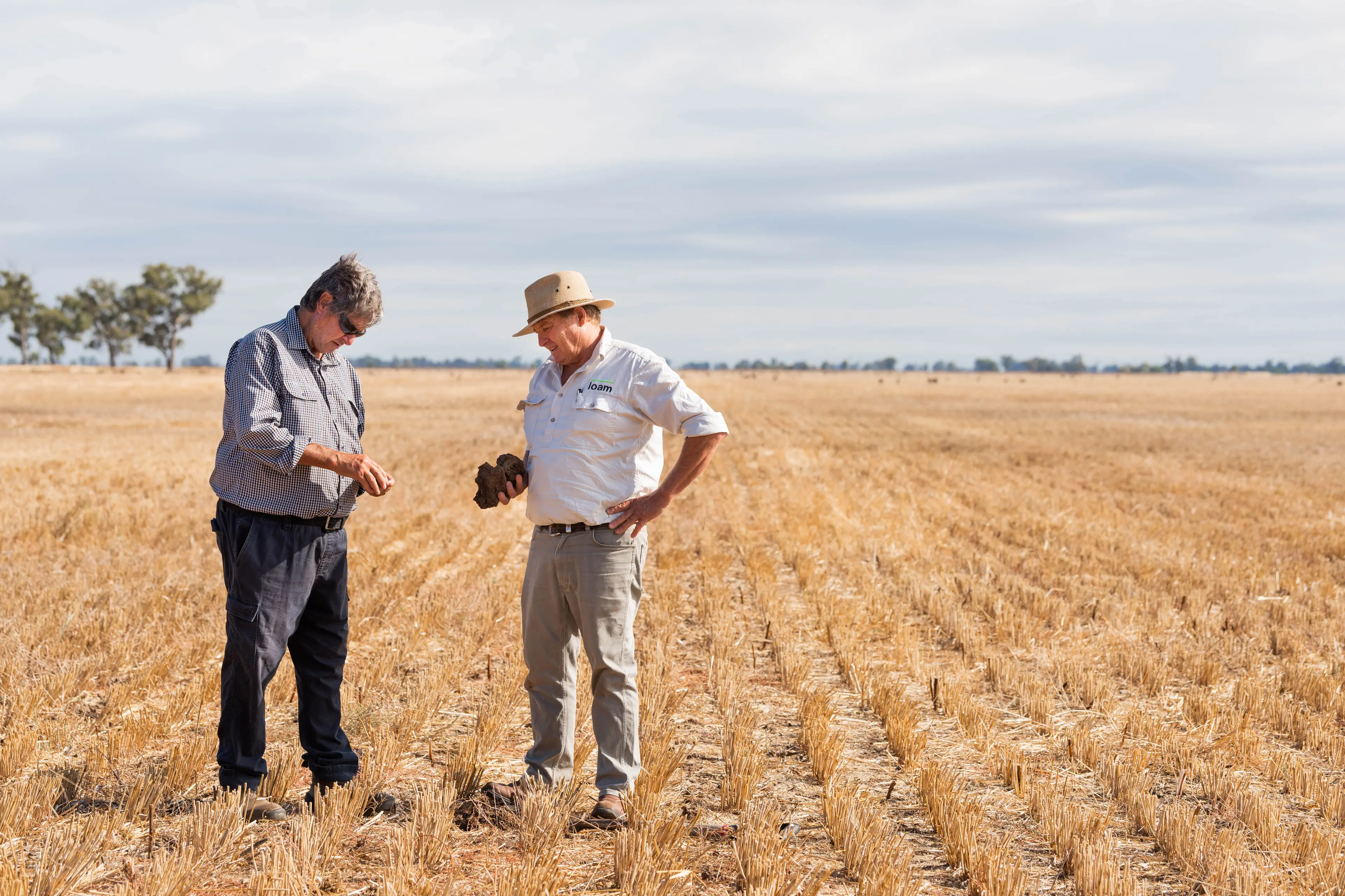
For Loam Bio co-founder Guy Webb, the achievement marks the culmination of more than a decade of work - and it's a bit of a "pinch me" moment.
Guy first encountered the concept at a carbon conference in Dubbo in 2012, where Sydney University researcher Professor Peter McGee outlined work on fungi capable of drawing carbon from the atmosphere and storing it in soil.
The idea that seed treatments could be used to build soil carbon across broadacre farming systems prompted further work, ultimately leading to the recent issuance of carbon credits.
“We’re at that point where we’re doing it for real, getting carbon credits paid, out in the landscape, so (Professor McGee's) original idea coming true really," Guy said.
That journey from concept to commercial reality as been "a helluva ride”.
The research has taken the team from the laboratory to the desert to collect fungi samples - prompting a rush for the state border to beat COVID lockdowns announced while they were out of mobile range and oblivious - and back again.
Securing funding also required a wide-ranging effort, including a TEDx presentation where Guy condensed the science into a 30-second pitch, along with social media and crowdfunding campaigns. The project even inspired a documentary that screened at independent film festivals.
Today, more than $150 million in venture capital, grain industry and government funding has been spent on research and development to lead to this month’s headlines.
The Nicholsons’ project is one of 27 covering about 40,000 hectares of cropping country from the Queensland border, across NSW and down into Victoria.
There’s a similar amount of country in the American mid-west with corn and soy crops and the voluntary carbon market there.
Work by the not-for-profit research organisation Soil C Quest 2031, where it all began, continues.
While the fungi now sits with Loam for commercialisation and growth, Soil C Quest continues research into all things carbon sequestration and is developing courses for farmers and advisors in the carbon space.
You can find out more at www.soilcquest.org.au/


THE NICHOLSON CARBON PROJECT
The Nicholson Carbon Project, part of a 4,000ha grazing and cropping operation at Garema, has successfully generated an issuance of 4867 tradeable ACCU across 881 hectares, each representing one tonne of carbon dioxide equivalent stored.
It's more than a decade since the Nicholson family began exploring more sustainable farming approaches to safeguard the future of their operation.
“We knew we couldn’t keep farming the same way,” owner Steve Nicholson said.
“If we didn’t adapt, the future of the farm wasn’t sustainable.”
After extensive research, they rolled out a suite of farm management changes, including modified crop rotations across wheat, barley and canola, pasture and pulse rotations, reduced tillage, and improved residue management.
In 2024 the Nicholsons added Loam Bio’s CarbonBuilder™ to their program, a world-first fungal seed treatment that integrates into existing farm operations to boost productivity.
“From year one we saw a measurable increase in soil carbon, equating to 5.5 ACCU allocated per hectare," Mr Nicholson said.
"It was a seamless integration and offered something the industry doesn't often get - a new income stream.
"In effect we are now growing a second crop from the same paddock: a crop above the ground, and a carbon asset below.
“That’s translated into 4,867 ACCU, but more importantly, it’s improved the soil, strengthened the resilience of the farm.
"The real strength is the science - it’s easily adoptable, easy to use and it's affordable.
"Right now, farmers are copping it, and we need solutions that actually work. This is one of them."
This marks one of the largest broadacre cropping projects that has met the strict requirements of Australia’s Clean Energy Regulator, demonstrating that carbon farming has moved from concept to a commercial and scalable reality.
Loam Bio CEO Guy Hudson said the result validates years of scientific development and opens new ground for the industry - pioneered in no small part by a handful of people from the central west including Forbes agronomist Guy Webb.
“Australian farmers are increasingly under pressure from every direction - diesel, fertiliser, climate, and commodity prices," Mr Hudson said.
"What the Nicholson family has achieved is a significant milestone - generating ACCU at commercial scale, backed by more than a decade of research across 70 scientists and eight universities.
"Historically broadacre farmers have largely been locked out of the carbon market. This result shows there's a reliable way in."