PHOTO
Domestic violence services in rural communities are still trying to support at least twice the number of women they are funded to.
They are not numbers, they are real women and children seeking help.
CatholicCare Wilcannia-Forbes, who offers domestic violence support from Forbes through to the far west, says systemic change is needed to give women the practical support they need.
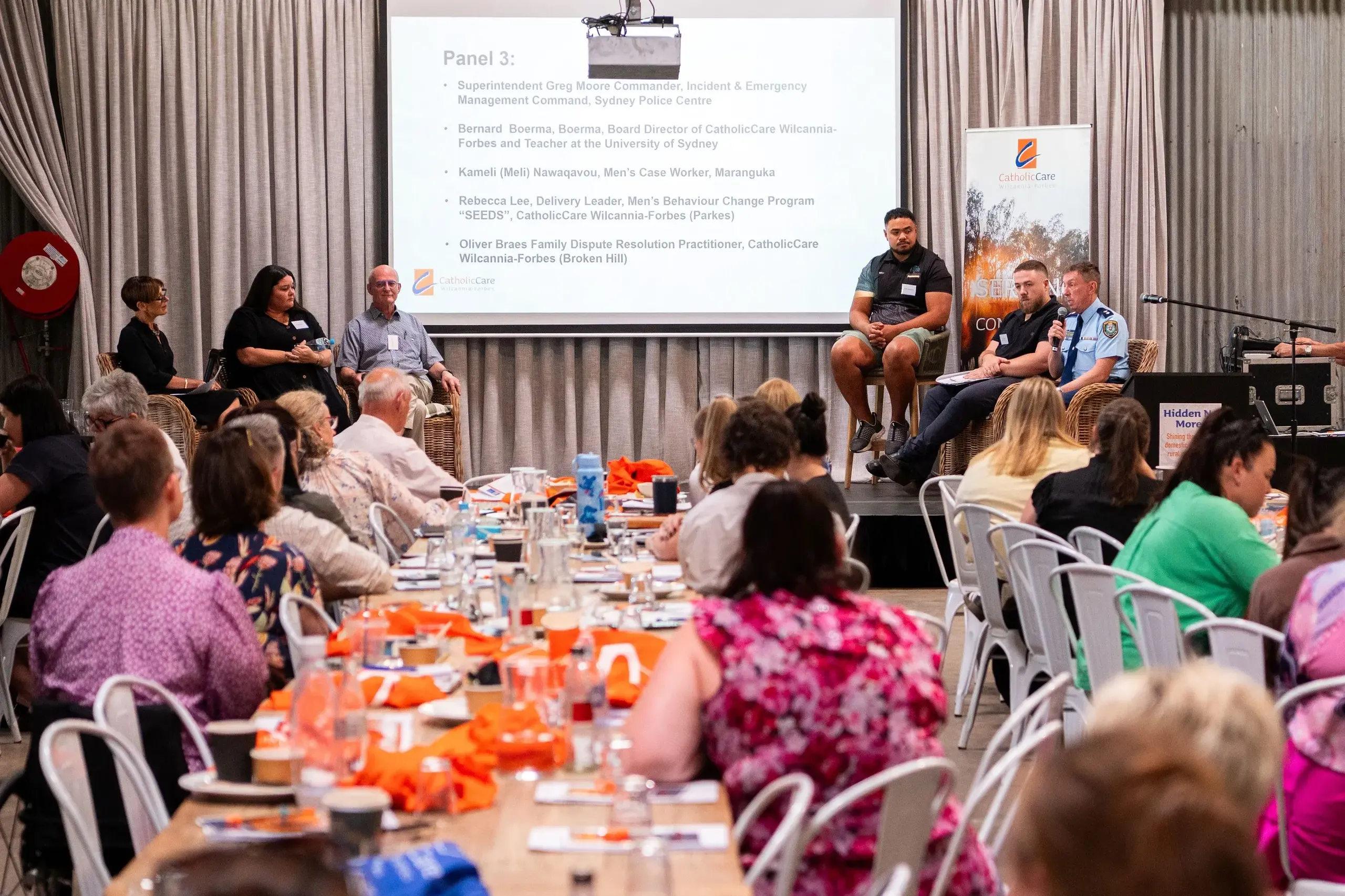
This is why CatholicCare Wilcannia-Forbes brought together frontline workers, community advocates and leading voices to drill into the realities of domestic violence in regional, rural and remote NSW.
Hidden No More: shining the light on domestic violence in rural communities brought together more than 100 committed people as an important step towards lasting and practical change.
Its keynote speakers were NSW Women’s Safety Commissioner Dr Hannah Tonkin, the Hon. Stephen Lawrence MLC, author, professor and investigative journalist Jess Hill, NSW Police Incident and Emergency Management Commander Superintendent Greg Moore, and Magistrate Aaron Tang, Local Court of NSW.
CatholicCare Wilcannia-Forbes team members from Broken Hill, Forbes, Narromine and Parkes were part of the program’s panel discussions, joined by other community leaders, frontline workers and advocates.
The Orana and Far West continues to record domestic violence-related assault rates more than three times the NSW average (BOCSAR June 2025).
In remote areas, women experience assault-related hospitalisations at 43 times the rate of women in major cities (AIHW May 2025).
“Those are statistics, but for our team, we see real women and children walking through the doors, and the damage domestic violence does to them,” CatholicCare Wilcannia-Forbes CEO Anne-Marie Mioche said after the symposium.
“The journey to safety is incredibly difficult, and support is often insufficient.
“We need systemic changes to give women the practical help they need.”
Ms Mioche said most of its domestic violence response services saw at least double the number of clients the organisation was funded for, and other providers faced similar pressures.
The vast area covered by CatholicCare Wilcannia-Forbes had the highest levels of disadvantage in the state, while at the same time, the further west in NSW, the fewer the services available, she said.
“We’re trying to protect women and their children in areas with very few services,” Ms Mioche said.
“Sometimes a woman fleeing violence must travel six hours by public transport to reach support that’s only one hour away by car.
“Services that are available in rural communities are often seeing two to three times the number of women they are funded to support.
“Policymakers may not see these barriers, but we must make them aware of these and they must be addressed, because they make our work far more difficult and the risks unacceptably high.”
Ms Mioche said she wanted both the federal and state governments to reassess funding allocations for regional and remote communities.
She urged investment in prevention strategies, including:
• more early intervention programs, for example, for teens to tackle attitudes
• programs for children dealing with domestic violence
• targeted support for men
CatholicCare Wilcannia-Forbes is a provider of the Men’s Behaviour Change Program, which Ms Mioche describes as having “huge potential to transform behaviour”.
“For the men who really embrace the program, it is not unusual for them to participate again by choice,” she said.
“That’s real and practical change in a man and that’s an avenue out of violence.
“We need more programs like this, giving men the tools and strategies to stop that behaviour.”
The organisation supported 118 men through this program in 2024 / 2025.
They also supported 32 female victim-survivors through the Men’s Behaviour Change Program women’s advocacy workers.
Ms Mioche said there was a tradition of self-help in the bush, and she highlighted the potential for community-led solutions, which could hold the keys to change.
She acknowledged CatholicCare Wilcannia-Forbes team members and other workers in the field, including police and lawmakers, saying it took courage and resilience to keep working in that sector.
“I know why we do it, we do it because we have hope, hope that we can change the outcome for that woman, for that child, and that one day, domestic violence can be diminished.
“And it’s hope that drives us to keep going.”
The numbers:
In 2024 / 2025 Catholic Care Wilcannia Forbes supported:
253 women through Staying Home, Leaving Violence;
120 women who were experiencing or had experienced domestic and violence through Specialist Homelessness Services;
20-25 per cent of CatholicCare Wilcannia-Forbes female clients accessing the general financial counselling service in 2024-25 were financially impacted by domestic violence.
If you or someone you know is experiencing domestic or family violence, you can reach out to 1800 RESPECT at 1800 737 732 24 hours a day, seven days a week.
In an emergency, always call 000 (triple zero)